

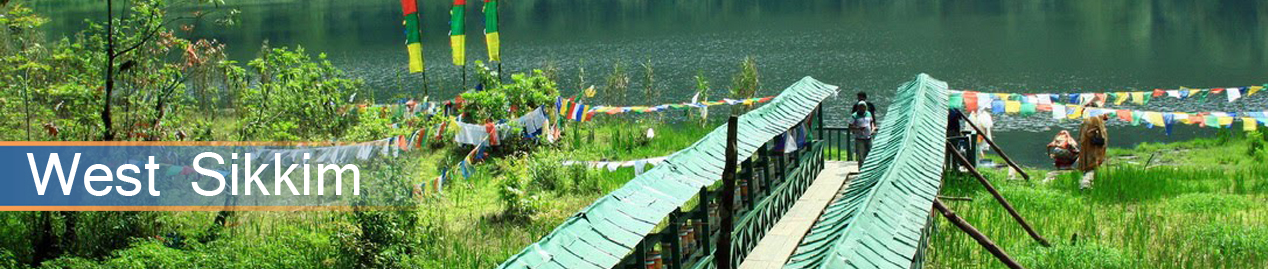
Go west for history. This is where the first Chogyal or monarch of Sikkim was coronated in 1641. A short distance away from Yuksom, the first capital of the Namgyal dynasty are the ruins of Rabdentse the second capital of the erstwhile kingdom. The West also has the oldest and most sacred of monasteries in Sikkim. Playing witness and guardians to time are the awe inspiring peaks of Khangchendzonga, Pandim, Kabru, Narsing that rise up from the dappled verdant silence of virgin woodlands of oak and walnut. The mountain ranges of West Sikkim are also famous for their azure, sacred lakes. There are seven lakes in and around Pemayangtse. The Khecheopalri Lake-the most sacred lake in Sikkim considered by many as a wish- fulfilling lake. Other lakes in this region are Sungmoteny Tso, Lamchho and Kabur Lamchho.
2.5 kms. From pelling and standini at 2085 m. The Perfecy Subline Lotus, perched on a wooded hilltop, commands the most sublime view of the Khangchendzonga. Built during the late 17th century, it is one the oldest and most important monasteries of the Nyingmapa order of this monastery who enjoy the title of ‘Tasang’ or pure monks. The importance of this monastery grew with time and reached its peak when only monaks from this monastery could anoint the reigning sovereign of the land with holy water. Pemayangtse monastery follows the Mindroling tradition besides holiday was founded by Minding Terchen Gyurme Dorje whose famous daughter Jetsum Migyur Paldon lived near Pemayangtse and tought there during her exile. Her stone throne is still to be seen in this monastery which has108 monaks. The main attraction of the monastery is the wooden replica of Zangdog Palri, the celestial abode of Guru Padmasanbhava built by Serdup Lhundrup Dorje Rinpoche in 1971. the annual chaam (monk dance) is held here on the 28th and 29th day of the 12th month of the Tibetan lunar calendar.
about 2kms. From Pelling, it is the second oldest Gumpa constructed by Gyalwa Lhatsun Chenpo
Sikkim’s second capital. The ruins Rabdentse are woeth exploring. The winding track through the forest brings you to a small set of ruins of the early town and eventually on to the ruins of the palace with chortens (stupa) nearby. Farther afield are the Changay Falls.
Shingshore Suspension Bridge is worth seeing-- length & gorge height is 680ft. It is the second highest bridge in Asia. The area also has its Khandu Sangphu or Hot spring and Cave.
Past the ruins of ancient towns below monasteries tended by red robed lamas lie the crystalline, wish fulfilling waters of Khecheoparli lake. The secred lake lies in a depression surrounded by prayer flags and forested hills. Above (1.5 km) is the Khecheopalri Gumpa.
Yuksom, The First Capital of Sikkim (1700M)- The first capital of the Kingdom of Sikkim and site of the coronation of the first Chogyal. Evidence of the enthronement ceremony can still be seen in the form of stone seats and a footprint of the Head Lama on a stone. The stone throne constructed for the great event stands today at Norbugang and has been declared a Heritage Site.
Located on a hilltop above Yuksom is the Dubdi Monastery (1701), the first monastery established after the consecration of the first Chogyal. Surrounded by verdant forests, it is an ideal place for lamas seeking meditation and recluse. Dubdi means “the Hermit’s cell” (hermit here, refers to Lhatsun Chenpo). Yuksom is a trail head for trekkers to Dzongri. Kathok Tsho at Yuksom is a sacred lake.
Famous for those lovely Sikkim rhododendron trails (over 20 varieties are known to grow here), pretty Bakkhim is the base for Dzongri. It's also the start-up point for mountaineers and trekkers going to Dzongri 10km away. The deafening silence is a balm to the senses as you are assaulted by the scents of those mountain herbs and flowering plants. The views of Khangchendzonga from here are truly memorable.
Sikkim’s most sacred monastery is perched atop a conical hill. A mere glance at the monastery is believed to absolve one of all sins. Common sights around the Gumpa are mantra engravings.
Built in 1716, Tashiding was described as the heart of “ Bayul Demoshong” (Sikkim was earlier known as Bayul Demoshong) by Guru Rimpoche. The complex in also the location of the “Thongwa Rongdol” Chorten. A mere glance of this sacred Stupa is said to wash away one’s sins. The monastery is also revered for the “Bumchu” festival during which the ‘Bumpa’ or vessel containing holy water is opened and a small quantity distributed to the devout. The origin of the water dates back to the time of Guru Padmasambhava in the 7th century and is said to contain sacred soil, water and precious jewels from all the holy places in India.The level of the water each year is considered the indicator of the times achead for this land.
Barsey Rhododendron Sanctuary is one among the five wildlife sanctuaries where most of the varieties of rhododendrons are found besides many medicinal herbs and plants. Rinchenpong is a base for treks to the Barsey Rhododendron Sanctuary and the Singalila Range. The panoramic view of the Khangchendzonga massiffrom here is unparalled.
Pelling is a fast growing urban settlement. Situated at an altitude of 6,100 ft. It offers a good view of the mountain ranges.Due to its locational advantages many hotels and lodges have mushroomed in and around Pelling.
This stunning hone of the red panda, black khaleej pheasant and the yellow-necked woodpecker is a trekker's delight. In season, Dzongri's verdant slopes are aflame with great varieties of rhododendron. From its peach its perch of over 3962 metres, it offers the most magical views of the Khangchendzonga massif. The Pandim Peak (6890 metres) is perpetually cloaked in thick snow. About 7 km way from Dzongri is Khangchendzonga base camp established by Darjeeling's Himalayan Mountaineering Institute.