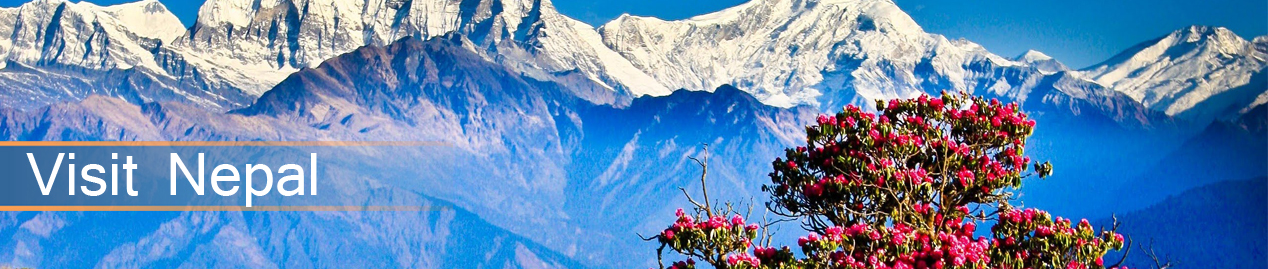
Nepal is a country of highly diverse and rich geography, culture, and religions. The mountainous north has eight of the world's ten highest mountains, including the highest, Sagarmatha, known in English as Mount Everest. The fertile and humid south is heavily urbanized. It contains over 240 peaks more than 20,000 ft (6,096 meters) above sea level.
Nepal has several ancient pilgrimage sites. Each temple is attached to a legend or belief that glorifies the miraculous powers of its deity. Kathmandu Valley is home to the famous Pashupatinath Temple, Swayambhu Stupa and several other famous temples. Hundreds of famous temples are located in and around the Kathmandu Valley. Some well-known pilgramage sites are: Barah Chhetra, Halesi Mahadev, Janakpur, Pathibhara, Tengboche in East Nepal; Manakaman, Gorkha, Lumbini, Muktinath, Gosainkunda, Tansen, Kathmandu Valley in Central Nepal; and Swargadwari, Khaptad Ashram in West Nepal.
Nepal is also the Gateway to Kailash Mansarovar, the mythical abode of Lord Shiva. Devotees from various parts of Nepal and India throng the temples during special festivals. Even though weak infrastructure renders some places hard to reach, efforts are being made on national level to develop and promote some popular sites.
Pilgrimage sites of Nepal like Muktinath and Gosainkunda make popular trekking destinations. Tours to these sites are encouraged for the novelty they provide in terms of nature and culture.
For over forty years, Nepal has been an extremely fascinating destination for travelers, scholars, and researchers. For those interested in culture, the Kathmandu valley is endowed with seven World Heritage sites. This valley was divided into three kingdoms less than a century ago. It now contains countless architectural monuments, and vestiges of varied cultural and religious traditions.
In other chapters we explain about the adventure Nepal provides, here we detail some of the more popular gentle sides of a holiday in our Kingdom including the Kathmandu Valley itself and other major settlements of interest in Nepal.
Kathmandu City
Kathmandu is known as Kantipur, the kingdom of Nepal. Here you will visit the temple of the living Goddess, who acknowledges the greetings of her devotees from balcony of her temple residence, Kathmandap-the source of the name Kathmandu. It was allegedly made from the timber of a single tree. Next, on to the Durbar Square area with its array of temples overlooked by the Hanuman Dhoka Palace, the ancient palace of the Nepalese Royalty.
Pashupatinath
Lying 6 Km from central Kathmandu, Pashupatinath temple is one of the holiest Hindu temples dedicated to Lord Shiva. Situated amidst a lush green natural setting on the bank of the sacred Bagmati river, the temple, which was built in pagoda style, has a gilded roof and beautifully carved silver doors. Visitors will be permitted to view the temple from the east bank of the Bagmati river, as entrance into the temple is strictly forbidden to all non-Hindus. Pashupatinath is the centre of an annual pilgrimage on the day Shivaratri, which falls in February or March. Behind the temples are the cremation grounds.
Dakshinkali
Literally meaning the Kali of the south, this temple is dedicated to the Goddess Kali, the Hindu goddess of power. Goats, chickens, ducks etc. are sacrificed on Tuesdays and Saturdays. The temple itself is located in a forested canyon and lies 19 Km. from Kathmandu.
Boudanath
This stupa, situated 11 Km. from the center of Kathmandu, is one of the biggest in the world of its kind. It stands with four pairs of eyes in the four cardinal directions, keeping a lookout for righteous behavior and human prosperity. This Buddhist stupa was built by King Man Deva at the advice of the Goddess Mani Jogini. It is built on an octagonal base and is contains inset prayer wheels. The shrine is surrounded by the homes of Lamas, or Buddhist priests.
Swayambhunath
Located approximately 3km from the center of Kathmandu, this Buddist stupa is said to be 2000 years old. The stupa which forms the main structure is composed of a solid hemisphere of brick and earth which supports a lofty conical spire capped by a pinnacle of gilt copper.
Painted on the four sided base below the spire are the all seeing eyes of lord Buddha. The whole area around the Stupa contains an array of small stupas and temples. This is one of the best places from which to view the Kathmandu valley, as it is situated an a small hillock.
Bhaktapur
Also known as BHADGAON meaning the city of devotes, this place is the home of medieval art and architecture. Lying 14Km east of kathmandu city. This place was founded in the 9th century and is shaped like a conch shell. The city is at the height of 4600 ft. Above sea level. In Bhaktapur you will visit the Durbar Square with its array of temples overlooked by the palace of 55 Windows built by King Bupatindra Malla, the Nytapola Teple. This temple, which was also built by king Bhupatindra Malla, is the best example of the Pagoda style and stands on five terraces, on each of which stands a pair of figures, famous strong men, elephants, lions, griffins and goddesses. Time permitting, a visit to the museum of Thanka painting can also be considered. A 30 minute walk brings you to the Dattatraya temple and Pujari Math which can also be done provided there is plenty of time at the clients' disposal.
Nagarkot
It is situated about 35Km. east of Kathmandu city and from here one can see Mt. Everet and other peaks of the Himalayas. Nagarkot is located between Kathmandu valley in the west and Indravati in the east.
The top of Nagarkot commmands accelerating views in all direction. The altitude of Nagarkot is 2229Mt. Above from sea level. It is also very popular for the viewing sunrise and sunset.